
How to Learn French in a Year: 4 Parts to Fluency
Hint simulate immersion.
This article will show you what it takes to learn French. I became fluent in two years, and you can do it in 1. It’s been done before by many people, and it’s entirely possible. Is it easy? No. It takes discipline and consistency for 365 days. But with the right tools, you’ll be fluent in French this time next year.
My story is typical. I spent many years in a classroom, doing exercises in a notebook and reading from a textbook with little to show for it. Then I got a scholarship to study in Paris for 1 month. That trip completely changed how I approached learning the language.
So I developed a new study strategy. And In two years, I was fluent.
I consider the years spent before my new strategy useless. That seems harsh, so let me explain. Whatever knowledge I gained wasn’t connected across my abilities to read, write, speak, and understand. It’s a bit like studying something in school, only to realize you’re empty-handed in the workplace. Ask an accounting major—they’ll tell you.
In a nutshell, you need to be proficient in reading, writing, listening, and speaking to be considered fluent. And most people learn in that order—I do not suggest taking that path. These are the 4 mediums of acquisition
- Methodology
- Resources
- Study plan, example day
- Habits
Methodology
There are a few theories on how to learn French. Some say immersion is the only way, others say you need a classroom setting to learn the basics, and others stipulate that you can’t be fluent unless you’re born of bilingual parents!
I want to be clear: the fastest way to learn French would be to immerse yourself in a rural French town, get rid of your car so you can’t leave, and work in a customer-facing role. You would be so desperately overloaded that you would learn just to survive (though this would be painful).
Languages are oral first. An infant learns through immersion—by needing to speak with his/her parents and thereby absorbing the language at a rapid pace.
But this type of full-immersion is not possible, though some have tried.
With the internet and international calling, you will never be totally immersed—that is, cut off entirely from any other language. There will always be times you call your family or spend time with English-speaking people.
Nevertheless, we should think about language learning as the process your brain goes through, during immersion, that leads to fluency.
So, what does full immersion really do for your brain? Well It creates urgency, gives you exposure to real interactions and common vocabulary, confronts you with common expressions, engages all your senses, and above all, is consistent. In list form, immersion:
- Creates urgency – because—unless you want to be very impolite—you need to say something, even if it’s “je ne parle pas français”
- Provides realistic interaction – because immersion is reality
- Reveals common vocabulary – because most books are outdated and don’t include common talk like slang
- Highlights expressions– because expressions are common, but not in academic study
- Engages all of your senses – because you smell, taste, see, hear, and feel a conversation
- Gives consistent exposure – because you have to speak throughout the day, every day
Unlike a textbook or a classroom setting, where the learning environment is pre-structured, immersion is organic.
Because full immersion isn’t really possible (except for children in public school), the best methodology is to simulate it in the closest way possible by reading, writing, listening, and speaking (the 4 mediums of acquisition) in equal increments.
This may sound obvious at first, but I challenge you to maintain an equal balance between the four in the long run.
In many ways, language learning is like dieting. You can start off with ambitious goals and a set plan. After a bit of time, you start to falter from the plan for one reason or another. The good news is that, unlike dieting, you will never completely lose the things you previously studied. They go dormant, sure, but you can activate them again.
In other words, you need to be determined about reading, writing, listening, and speaking, and you need practice them in a way that creates urgency, simulates real situations, emphasizes common vocabulary, highlights expressions, engages all of your senses, and you need do so consistently.
The balanced strategy
The balanced strategy is dedicating an equal amount of time to the 4 mediums of acquisition. This means that for every hour of study, you should devote 15 minutes to speaking, 15 to listening, 15 to reading, and 15 to writing.
It may sound obvious, but I challenge you to execute this for 1 full year.
To create urgency, you need to watch videos and speak out loud to yourself. To simulate real interaction, you need to watch YouTube channels and speak out loud to yourself. To hear common vocabulary, you need to only consume media produced in France.
To highlight expressions, you need to only consume media produced in France. To engage all your senses, you need to take up French cuisine. To get consistent exposure, you need to study throughout the day. Don’t worry—I will lay this out more constructively in the study plan.
Putting the pieces together
Your study plan needs to simulate immersion in the 6 ways we have discussed, and it needs to incorporate the balanced strategy. Here’s a table to illustrate:
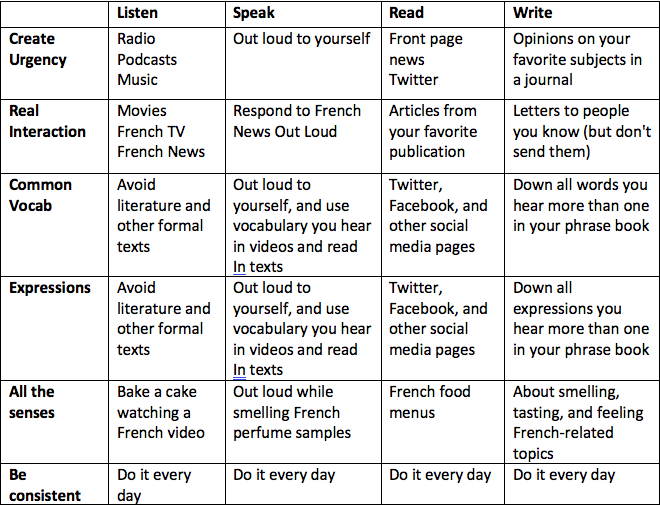
Learning Resources
I’m the kind of person who finds good resources and sticks with them. Here are a few app and website resources each of the four mediums of acquisition that I used for practice.
Listening (/watching):
Netflix – here you can watch French movies in their original languages or use French dubbing on English movies
Radio Française – app in Google Play and App Store. This app was huge for me because its various stations help provide a break to the 24-hour news cycle.
Quizlet – lets you build flash cards virtually and will even pronounce French words for you.
Speak:
Out loud to yourself – there are apps you can use to meet people for language exchange, but it’s very hard to find a long-term teacher on them, and they don’t replace the consistency available in speaking to yourself.
Read:
Write:
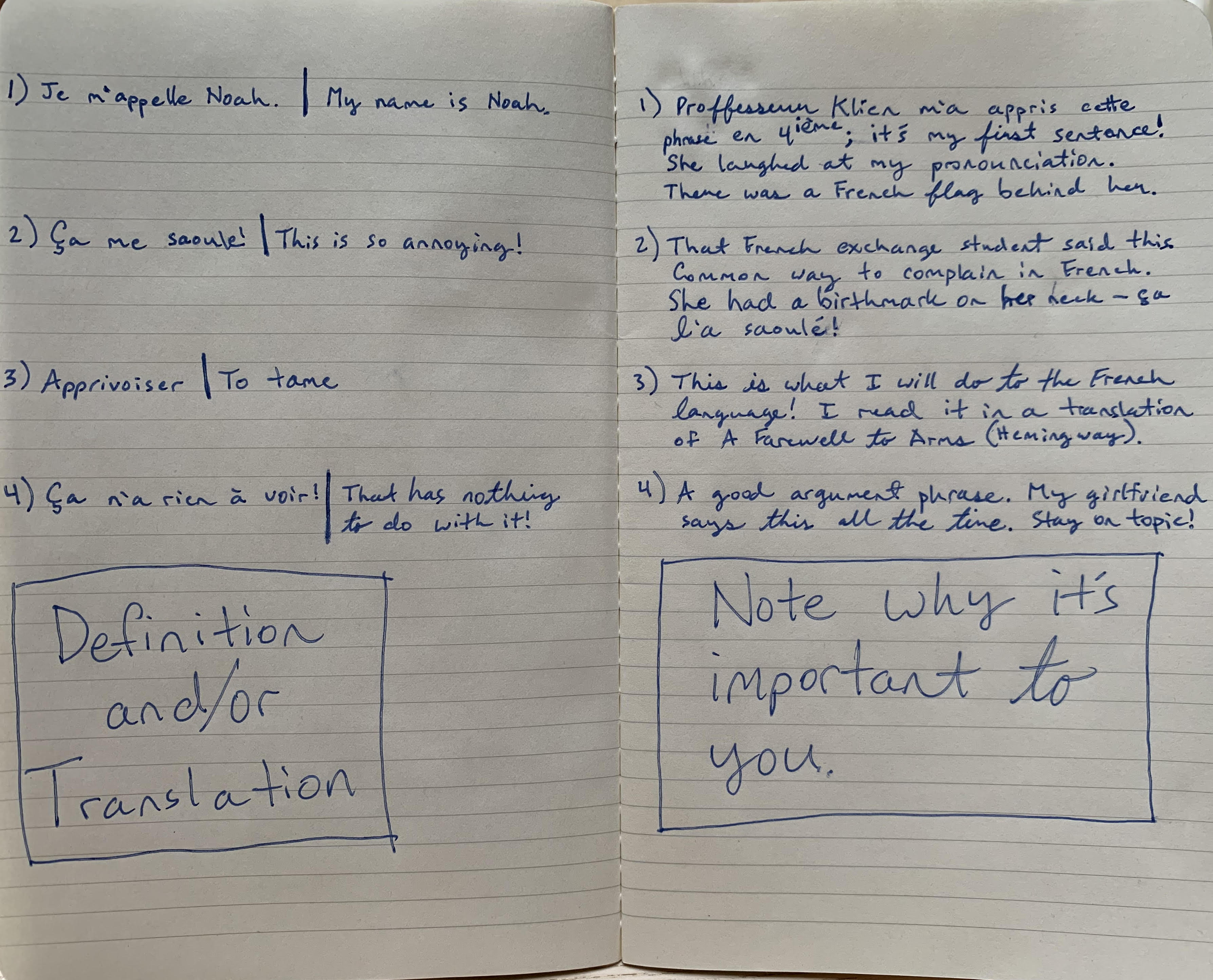
Phrasebook– for vocabulary and expressions
Notebook – for practicing written expression. Make this your one and only tool for written practice. If you write consistently, over time you will see your progress, which is intensely gratifying.
Sample daily study plan
ou might wonder how you can incorporate all of this information into a study plan. In some ways, you can. In other ways, you’ll need to be more inventive in how you approach the language.
You’ll need to be industrial about your study tactics. One hour a day is not likely to work; first because it’s not enough time, second because it’s too concentrated for your brain to manage, and third, because you probably won’t stick to it (after all, have you stuck to your New Year’s resolution?).
I’ve talked a lot about consistency. Consistency is important not only on a day-to-day basis, but also hour-to-hour. The more times you can practice some of the language per day, even just for a few minutes, the better.
At my peak, I was putting in 3 hours/day of quality study time. That means I was deep into resources for three hours each day… but not in one sitting! Here’s a chart to show you what I did:

You can see that my total comes out to around 3 and 3/4 hours. This wasn’t the case every day. Some days it’s better to do less to give your mind a break, and some days regular daily obligations will make it impossible to get in 3 hours of study time.
The real pleasure of this style is that you will see results without feeling like you’re grinding. When you watch videos and listen to the radio, your mind automatically starts picking up details, whether you realize it or not.
Habits
You’ve probably heard that it takes 30 days to create or break a habit. The same is true in French, and there are three major ones to help you learn French.
- Active listening
- Going to French first
- Keeping a phrasebook and notebook
Active listening means you focus on the meaning and the vocabulary you hear. Especially in the beginning, it’s very tempting to “pretend” to listen while you really just hear the equivalent of French mumbo jumbo. Active listening on a consistent basis will skyrocket your progress.
f you catch yourself drifting, that’s okay. Remember your goal is to learn French, and bring your attention back to the voice on the screen/through the speakers.
Going to French first means whenever you think of an idea, have a question, or need any sort of information, you look for it in French first. This is a tough one to create because you’re more anxious for the results than practicing. But if you learn this, you’ll progress much faster.
A good way to set yourself up for success is changing your phone and computer languages into French. This will force you to develop the knee-jerk reaction of searching in French.
Keeping a phrasebook and notebook means getting two big, sturdy spiral notebooks that you’ll use for at least one year. Keep these on you all the time. In the phrasebook you’ll write words and expressions, their definitions, and what they mean to you. In the notebook, you’ll write practice passages in French. This could be letters to friends or self-reflective entries.